
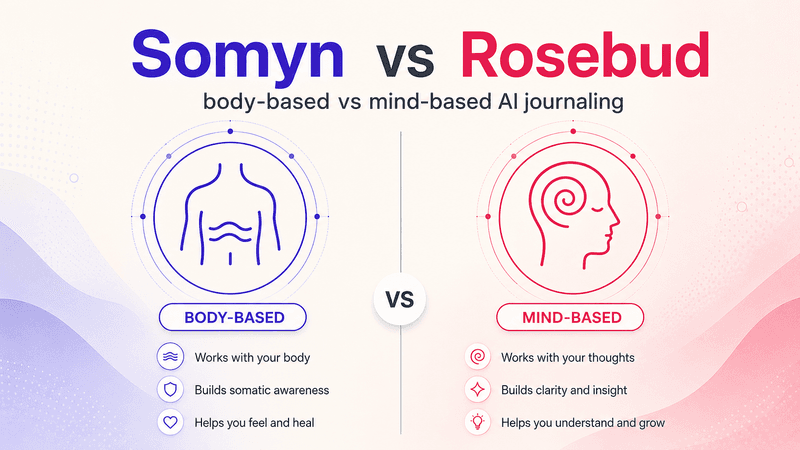
Quick comparison
Somyn | Rosebud | |
|---|---|---|
Core focus | Body and emotion together: food, movement, hydration, body signals | Thoughts and emotions through AI conversation |
Best for | People connecting mood to their body, or recovering from numbers-driven wellness | People working through thoughts and emotions in conversation with AI |
Tracking style | Words and feelings, no scores or calorie counts | Goals, streaks, and mood tracking with counts |
AI companion | SomaGuide, reflective. 5 messages a day free, unlimited on Plus | Conversational AI with adaptive follow-ups and long-term memory |
Weekly summaries | Available on Plus | Included with Bloom |
Therapy frameworks | Built for use alongside therapists, dietitians, coaches | IFS, ACT, shadow work, gratitude, dream journals |
Standout features | Body check-ins, Relational Mirror, tarot reflection | Long-term memory, 20-language voice, guided workbooks |
Price | Free forever core, Plus $8/month | Free tier with daily limits, Bloom $12.99/month |
Platforms | Web, Android, Apple via home screen | Native iOS and Android, plus web |
Maturity | Newer, smaller | Established, well-funded, widely used |
Choose Somyn if
Your reflection isn't only about what you're thinking, it's about what your body is doing. Somyn lets you notice that you felt irritable, skipped breakfast, slept poorly, and took a walk, and then see those things together instead of as separate notes. It logs food, movement, and hydration in words rather than calories or counts, which makes it a fit if you're recovering from disordered eating or exercise patterns, or if numbers-driven wellness apps have left you feeling judged. It's also built to work alongside a therapist, dietitian, or coach, so if you want to track what's happening between sessions and arrive with clarity, that's a real use case Rosebud doesn't serve. Somyn's core is free forever, and Plus is $8 a month.
Choose Rosebud if
Your reflection is mostly about working through your thoughts and emotions, and you want a developed AI conversation to guide it. Rosebud asks adaptive follow-up questions and remembers your history across entries with long-term memory. It offers structured therapy frameworks like Internal Family Systems, Acceptance and Commitment, and shadow work, and it has native iOS and Android apps alongside its web version. If you want to process anxiety, overthinking, or a difficult event through guided writing or voice, this is what Rosebud is built for. TrendGap
Where they actually differ
The first difference is body versus mind. Somyn is built around physical experience, hunger and fullness cues, how movement felt, hydration, tension and fatigue, and it connects those to emotion. Rosebud is built around thinking and emotional processing through conversation. Both let you type or speak your entries, and both track mood, so the difference isn't the format, it's what each one asks you to pay attention to: your thoughts, or your body.
The second difference is measurement. Rosebud uses goals, streaks, and counts, which suits people who like structure and progress markers. Somyn deliberately avoids scores and numbers on food and movement, which suits people for whom numbers and scores make wellness feel worse, not better. These are opposite design philosophies, and the right one depends on your relationship with tracking.
The third difference is who each serves. Somyn has a provider side for therapists, dietitians, and coaches, with a client-facing tool for between-session reflection. Rosebud is a direct-to-consumer app for personal use.
Honest pros and cons
Somyn strengths: it connects mind and body in one place, it handles food and movement without numbers, it fits therapy and coaching workflows, it's privacy-first by design, and its core is free with a cheaper paid tier. Somyn limits: it's newer and smaller, it's web-first with no native iOS app yet (Apple users add it to the home screen), some features like guided body scans are still coming, and its AI companion is younger than Rosebud's.
Rosebud strengths: a mature conversational AI, long-term memory across entries, established therapy frameworks, native mobile apps, strong funding, and a large user base. Rosebud limits: at $12.99 a month it's one of the most expensive journaling apps, it caps AI interactions per day on lower tiers, which can interrupt a session, and its terms allow anonymized journal data to be used for AI training with no opt-out. It also stays focused on thoughts and emotions, with no body, food, or movement dimension. App Store
When each one fits
Someone recovering from disordered eating who wants to rebuild a gentle relationship with food and movement, without calorie counts, will likely do better with Somyn. Someone navigating a hard stretch of anxiety or a relationship decision who wants to work through it with a responsive AI that remembers the backstory will likely prefer Rosebud. Someone in therapy who wants to capture what their body is carrying between sessions fits Somyn. Many people could use both, Rosebud to think through what's on their mind, Somyn to notice what's happening in their body.
Common questions
Do I want a journal or a broader reflection tool? Both are journals. The question is scope. Rosebud stays with your thoughts and emotions. Somyn adds your body, food, movement, and hydration, alongside emotion.
How does the AI actually help in each? Rosebud's AI holds a conversation and remembers your history. Somyn's SomaGuide reflects your patterns back and helps you notice links between mood and body, without diagnosing.
Which is better for understanding myself over time? Both show patterns. Rosebud surfaces emotional and thematic patterns from your entries. Somyn surfaces patterns across mood, food, movement, and body signals.
Can I use it without journaling every day? Yes for both, and especially Somyn, where a quick body check-in, mood note, or voice memo counts without needing paragraphs.
Is Somyn a cheaper alternative to Rosebud? Somyn's paid tier is cheaper at $8 versus $12.99, but they're not the same tool. Somyn adds the body dimension Rosebud doesn't have, and Rosebud has the more developed AI conversation.
Which is better if I'm recovering from disordered eating? Somyn is designed with this in mind, tracking food and movement without numbers or scores. Anyone with a clinical condition should still work with a professional.
The bottom line
This isn't a case of one app beating the other. They're built on two different ideas of what self-understanding means. Rosebud helps you think and write your way to clarity, with a mature, guided AI journaling experience. Somyn helps you notice what your body is doing and connect it to how you feel, which Rosebud doesn't attempt. Choose by which kind of reflection you actually want, and know that for some people the honest answer is both.
Comments (0)
Sign in to leave a comment.
No comments yet. Be the first to share your thoughts.