
You have launched your SaaS.
The product works. Your website is online. People can sign up and start using it.
Now comes the difficult part.
How do you find your first customers?
There are plenty of things you could do. You could work on SEO, publish content, run ads, post on social media, submit your product to directories, or launch on a startup platform.
The problem is that you don't yet know which of these activities will actually bring you customers.
For a new SaaS, I would start somewhere much simpler.
Find people who have the problem your product solves. Talk to them. Get them to try the product. Help them use it. Then learn from what happens.
This approach is often called founder-led customer acquisition.
Paul Graham described a similar approach in his well-known essay "Do Things That Don't Scale." His advice is that early-stage founders should actively recruit users and personally help them get started instead of waiting for customers to arrive on their own.
The experience of Merge shows the same idea in a SaaS business. Its founders spent the early months doing sales themselves. Those conversations helped them understand their customers, improve their messaging, and improve the product.
So let's turn that idea into a practical plan.
Start with one type of customer
The first thing you need is a clear idea of who you want to sell to.
Don't start with:
"My SaaS is for businesses."
That's too broad.
Instead, describe a specific type of customer.
For example:
"My SaaS is for small software companies that need to monitor customer feedback."
Or:
"My SaaS is for freelance developers who manage websites for several clients."
The right description depends on your product.
At this stage, you don't need to prove that this is your final target market. You need a specific group to start talking to.
Write down:
Who the customer is
What job they do
What problem they have
How they solve the problem today
What is frustrating about their current solution
Why they might want your product
Then write one simple sentence:
I help [type of customer] solve [specific problem].
Keep it simple.
You will probably change this description after talking to customers.
Make your website ready for those conversations
Your website does not need to be perfect.
It needs to explain the product clearly.
A potential customer should quickly understand:
What your product does
Who it is for
What problem it solves
How much it costs
How to try it
A short product video can help if the product is difficult to understand from a screenshot.
A comparison page can also be useful when customers commonly compare different solutions.
But don't spend weeks preparing marketing material.
Your website is there to support your customer acquisition work.
It is not the customer acquisition strategy itself.
Find your first 50 potential customers
Now find people who might genuinely need your product.
Start with around 50 people.
Look in places where your potential customers already spend time:
LinkedIn
Industry communities
Reddit
Slack groups
Discord communities
Professional groups
Developer communities
Your existing network
Companies that have the problem you solve
Don't worry about building a huge database.
You are looking for people you can actually talk to.
A simple spreadsheet is enough:
Person | Company | Why they might need the product | Contact | Status |
|---|---|---|---|---|
John | ABC | Has the problem I solve | Not contacted | |
Sarah | XYZ | Uses a related solution | Contacted | |
Mike | DEF | Strong fit for the product | Demo |
The reason for doing this manually is simple.
You want to understand who responds.
That information will help you build a better prospect list later.
Talk to potential customers
Now contact people from your list.
Start with around 5–10 personal messages per day.
Don't send the same generic sales message to everyone.
Instead, explain why you are contacting that particular person.
Your first objective is not to close a sale.
It is to understand the problem.
You can say:
"I'm building a product that helps [type of customer] solve [problem]. I'm talking to people who deal with this problem to understand how they handle it today. Would you be open to a short conversation?"
Then ask questions about their actual experience.
For example:
How do you handle this today?
When did you last have this problem?
What did you do?
What is difficult about your current solution?
Have you tried other solutions?
Are you paying for anything today?
How often does this problem happen?
What happens when the problem isn't solved?
One of the most useful questions is:
"Can you tell me about the last time this happened?"
This is much better than asking:
"Would you use a product that does this?"
People are often positive about hypothetical products.
Their real behavior tells you much more.
Show the product to people who have the problem
Once you find someone who clearly has the problem, show them your SaaS.
You can schedule a short demo.
Or, if the product is simple enough, invite them to try it.
Watch what happens.
Pay attention when they:
Don't understand something
Ask an unexpected question
Look for a feature you don't have
Stop during the signup process
Get confused by the interface
Become interested in a particular feature
These moments give you useful information.
You are learning what prevents people from getting value from the product.
Personally help your first customers
For your first few customers, don't be afraid to do things manually.
Offer to help them get started.
You might:
Create their account
Configure the product
Import their data
Set up an integration
Create their first project
Walk them through the main workflow
Paul Graham describes this type of work as "doing things that don't scale." The idea is not that manual work is good forever. The idea is that early founders can learn a lot from personally helping customers.
Suppose you personally help ten customers.
If seven of them get stuck at the same step, you have found a product problem.
You can fix that step.
Later, you might turn the manual process into an onboarding screen, a setup wizard, or an automated workflow.
That is how manual work can eventually lead to a better product.
Ask for payment
At some point, you need to find out whether people will pay.
A free beta can be useful when you are still testing the product.
But don't make "free users" your main measure of progress.
Look at the whole journey:
Visitor → signup → active user → customer
An active user has actually received value from the product.
A customer has decided that the value is worth paying for.
You can offer early customers a special price if that makes sense.
For example, you might offer founding customers a discount for the first year.
The important thing is to learn whether the problem is valuable enough for people to spend money solving it.
Ask every new customer where they came from
Once someone becomes a customer, ask:
"How did you hear about us?"
Also ask:
"What made you decide to try the product?"
And:
"Was there anything that almost stopped you from signing up?"
Write down the answers.
You may start seeing a pattern.
Perhaps most customers came from LinkedIn.
Perhaps they came from a particular community.
Perhaps someone recommended the product.
Perhaps they found you while searching for a solution.
These answers tell you where to focus next.
Start testing one acquisition channel
After you have talked to your first customers, start looking for a repeatable acquisition channel.
Don't try everything at once.
Pick one channel that makes sense for your customers.
It could be:
Direct outreach
LinkedIn
A professional community
Reddit
Content
Search
Referrals
SaaS discovery platforms
If direct outreach is working, do more of it.
If one community is producing good customers, spend more time there.
If customers are finding you through search, start creating more content around the searches that bring them to your site.
The goal is to discover one channel that can repeatedly produce good customers.
You can add other channels later.
Use SaaS discovery as part of the mix
SaaS discovery platforms can give your product another place to be found.
This is where SaaS Hive can be useful.
SaaS Hive gives SaaS founders a dedicated product page where they can present their product, pricing, screenshots, and other information.
A product page also gives potential customers another way to learn about your SaaS.
You can use it when someone asks:
"Where can I learn more about your product?"
Instead of sending only your homepage, you can give them another product-focused page with the information they need.
SaaS Hive also gives SaaS products an ongoing presence after launch. Your product does not have to depend entirely on a single launch event.
I would still treat this as one part of your acquisition strategy.
It should work alongside direct outreach, customer conversations, communities, referrals, and content.
Ask happy customers for referrals
Once a customer is getting real value from your product, ask a simple question:
"Do you know anyone else who has this problem?"
Don't make the question complicated.
You are not asking every customer to become a salesperson.
You are simply giving a satisfied customer an opportunity to introduce someone who might benefit from the product.
You can also ask for a testimonial.
A useful testimonial explains:
What problem the customer had
How they were solving it before
Why they tried your product
What changed after they started using it
That is much more useful than:
"Great product!"
Create content from what customers tell you
Content becomes much easier when you stop guessing what people want to read.
Your customer conversations give you topics.
If several customers ask the same question, write an article about it.
If customers don't understand a particular part of the problem, explain it.
If people regularly compare different approaches, write a comparison.
Good early content might look like:
How to solve [specific problem]
How to automate [specific workflow]
How to choose a solution for [specific problem]
[Problem] without [common painful approach]
What we learned from helping our first customers
This content can help future customers find your product.
It can also give you something useful to share when you contact prospects.
What about directories and paid advertising?
You can add these channels later.
Directories can give your product more places to be discovered. SaaS Hive can be part of this discovery strategy.
But I would not spend most of your first month submitting your product to dozens of directories.
The same applies to paid advertising.
Advertising can bring visitors to your website.
But if you don't yet know who converts into a customer, you are paying to learn something you can often learn more cheaply through direct conversations.
Once you know who your customers are and what message converts, paid advertising becomes much easier to evaluate.
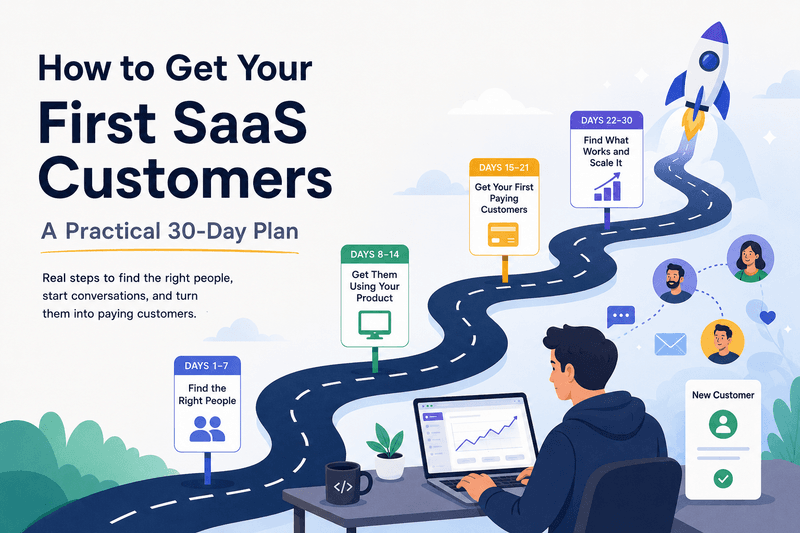
Your first 30 days
Here is the complete process.
Week 1: Find the right people
Define your first customer group.
Prepare your website.
Create a list of 50 potential customers.
Contact 5–10 people each day.
Start conversations.
Your main goal is to learn.
Week 2: Get people using the product
Continue talking to potential customers.
Give product demos.
Invite good prospects to try the product.
Personally help them get started.
Watch where they struggle.
Fix the biggest problems you discover.
Week 3: Get your first paying customers
Follow up with people who tried the product.
Ask successful users to become paying customers.
Ask every customer how they found you.
Ask what made them decide to try the product.
Ask what almost stopped them.
Create or improve your SaaS Hive product page.
Start collecting genuine feedback and testimonials from customers who have used the product.
Week 4: Find what works
Look at your first customers.
Where did they come from?
Which type of customer converted?
Which message worked?
Which objections came up repeatedly?
Then choose one acquisition channel to focus on.
Increase the activity that is producing good customers.
Don't add five new channels at once.
What should you measure?
You don't need a complicated growth dashboard.
A simple spreadsheet is enough.
Track:
Metric | What it tells you |
|---|---|
People contacted | Outreach activity |
Conversations | Interest in the problem |
Product demos | Interest in your solution |
Signups | Product interest |
Active users | Whether people are getting value |
Paying customers | Willingness to pay |
Customer source | Which channels produce customers |
Cancellations | Retention problems |
One number is especially useful:
Paying customers by acquisition source.
For example, suppose you get 20 signups from one channel but no paying customers.
Another channel gives you five signups and two paying customers.
The second channel is more interesting.
Don't optimize for the number of visitors or signups.
Look for the channels that produce customers who actually use and pay for the product.
What I would not do during the first month
There are many things you could work on after launching your SaaS.
You could redesign your website.
You could write 30 articles.
You could run Google Ads.
You could create social media accounts on every platform.
You could submit your product to hundreds of directories.
You could build an affiliate program.
You could prepare a huge launch campaign.
Most of these things can be useful later.
But they can also become a way to avoid talking to customers.
During the first month, I would keep the focus narrow:
Find people who have the problem.
Talk to them.
Show them the product.
Help them use it.
Ask them to pay.
Learn from what happens.
Then repeat the process.
The process changes as your SaaS grows
Your acquisition strategy should change as you learn more.
Your first few customers: Learn
Do the work manually.
Talk to customers.
Give demos.
Personally help people get started.
Learn why they buy and why they don't.
Your next group of customers: Find a repeatable channel
Test targeted outreach.
Test a relevant community.
Ask for referrals.
Track where customers come from.
Look for one channel that produces good customers consistently.
After that: Expand
Once you know what works, add other channels.
You can invest more time in:
Content
SEO
SaaS discovery
Directories
Referrals
Partnerships
Paid advertising
Product-led growth
Now these activities have a better foundation.
You know who you are trying to reach.
You know what problem they care about.
And you have real customers who can tell you what works.
The main lesson
Finding your first SaaS customers doesn't have to start with a complicated marketing strategy.
Start with people.
Find a small group of people who probably have the problem you solve.
Talk to them.
Learn how they solve the problem today.
Show them your product.
Help them get value from it.
Ask them to pay.
Then look at where those customers came from and repeat what worked.
Your first customers are not just a source of revenue.
They are also a source of information.
They help you discover who your product is really for, what message works, what needs to change, and which acquisition channels are worth your time.
Once you understand that, you can start building a much larger customer acquisition system.
First learn what works. Then scale it.
Comments (0)
Sign in to leave a comment.
No comments yet. Be the first to share your thoughts.