

Milosh Mladenovski is a UX/UI designer at Tieto, one of the top 10 largest companies in Europe, where he builds digital solutions for the Norwegian government. He kept watching businesses bleed money on software subscriptions nobody remembered signing up for. He spent around $10K and six months building CostLoop, a simple subscription tracker for small businesses who don't need enterprise tools. Then one user told him, "I didn't realize how many subscriptions we actually had." That was the validation.
Product: CostLoop Category: SaaS Management / Productivity Founded: 2026 Team size: Solo founder
Website: costloop.app SaaS Hive page: https://www.saashive.com/products/costloop
What were you doing before CostLoop, and how did the idea come to you?
I work as a UX/UI designer at Tieto, one of the top 10 largest companies in Europe, where we build digital solutions for the Norwegian government. Through that work, I kept noticing the same problem. Businesses were signing up for more and more software, but after a while nobody really knew what they were paying for anymore. Renewals happened automatically, former employees left subscriptions behind, and invoices, contracts, and cancellation links were scattered across different emails and folders.
I looked at the existing SaaS management tools, but most of them were designed for large enterprises, required complex integrations or bank connections, and were too expensive or overwhelming for smaller businesses. That's what inspired me to build CostLoop.
In one or two sentences, what does CostLoop do and who is it for?
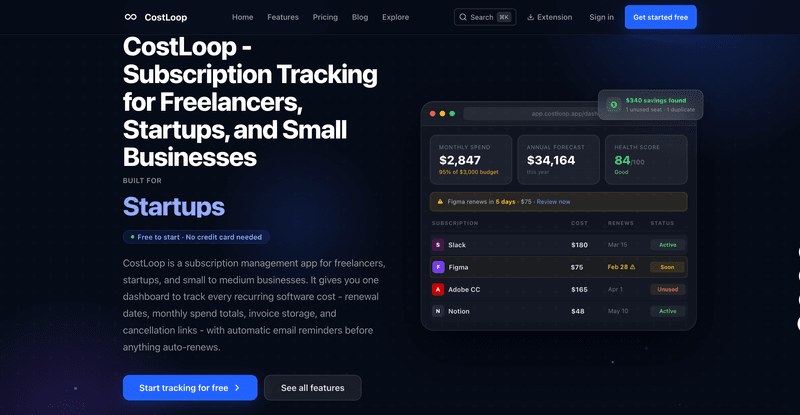
CostLoop helps small and medium businesses, startups, and freelancers track and control their software subscriptions in one place. It gives teams a clear view of costs, renewals, owners, invoices, and cancellation details so they can avoid wasted spend and surprise charges.
How long did it take to build your first version, and how much did it cost to get there?
The first version took about six months. I invested roughly $2,000 to $2,500 on licenses and tools alone. When you factor in time and other investment, the real cost was closer to $10,000.
What did you spend time or money on that turned out to be a complete waste?
Polishing too much before validating. I spent time perfecting UI details and secondary workflows when early conversations with users showed they cared much more about quickly seeing all of their subscriptions, renewal dates, and costs. That shifted my focus toward solving the core problem first instead of perfecting things nobody was asking for.
How did you get your first users?
A mix of social media, SEO, AI search visibility, and AppSumo, where we offer lifetime licenses. AppSumo has generated the most paying users so far. It provided our first real revenue and validated that businesses are willing to pay for the problem CostLoop solves. SEO and AI visibility are still long-term investments, while social media has mainly helped build awareness.
What's one decision you've made so far that had the biggest positive impact on your product or business?
Keeping CostLoop simple instead of trying to compete with enterprise SaaS management platforms. Rather than relying on complex integrations or bank connections, we focused on giving businesses an easy way to manually manage their subscriptions, renewals, invoices, contracts, and cancellation details in one place. We've intentionally postponed complex integrations because users consistently tell us they value simplicity and visibility more than connecting dozens of external tools.
What's the best feedback or reaction you've gotten from someone who's tried CostLoop?
One user said, "I didn't realize how many subscriptions we actually had until I put everything into CostLoop." That was exactly the problem we set out to solve.
What's been the lowest moment so far? What did you change as a result?
Realizing that simply launching wasn't enough. I expected more organic traffic and signups early on, but growth was much slower than I anticipated. That pushed me to invest much more time into SEO, AI visibility, content marketing, guest posting, and product listings instead of relying on the launch itself.
How do you decide what to work on next? What gets priority and what gets ignored?
One feature we added based on user feedback was price increase detection. Several users told us they didn't realize some of their software subscriptions had quietly increased in price over time until they reviewed their spending. We also expanded each subscription entry to include invoices, contracts, and cancellation links, so everything is stored in one place instead of scattered across emails and folders.
If a problem comes up repeatedly from users, it moves to the top. If something is too niche or too complex without clear demand, we leave it until there's real evidence it's worth building.
What's the one reason someone would pick CostLoop over the alternatives?
Most SaaS management tools are built for large enterprises with big budgets and IT teams. CostLoop is built for small businesses and freelancers who want to see what they're paying for without a complex setup. You can start tracking everything in minutes, not weeks.
Where can people find or try CostLoop?
Try it at costloop.app
Follow CostLoop on LinkedIn: CostLoop
Follow on X: @costloopapp
Follow on Instagram: @costloopapp
This interview has been lightly edited for clarity and flow. All answers are Milosh's own words.
Comments (0)
Sign in to leave a comment.
No comments yet. Be the first to share your thoughts.