
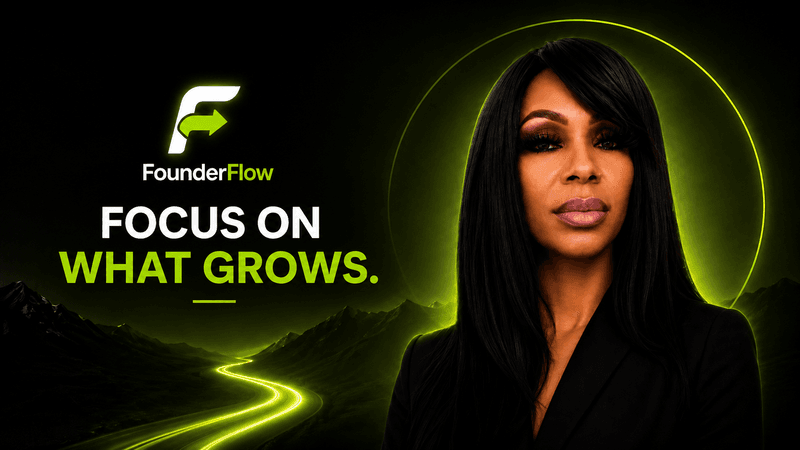
Stacy Wycoff was running two residential care homes in California, earning a master's degree, and wearing every hat a business owner wears. Then she missed a critical government survey buried in her inbox and lost thousands of dollars in monthly reimbursement. The information was right there. Nothing flagged it. She didn't build another email tool. She built an AI Executive Chief of Staff that tells founders what actually matters before it's too late.
Product: FounderFlow
Category: AI / Productivity / Executive Intelligence
Founded: 2026
Team size: Founder + engineering team
Website: founderflowhq.ai
SaaS Hive page: https://saashive.com/products/founderflow
What were you doing before FounderFlow, and how did the idea come to you?
I was running two Level 3 adult residential care homes in California while also earning my master's degree in Organizational Development. Like many founders, I wore every hat imaginable. My inbox, calendar, meetings, compliance deadlines, customer conversations, and business decisions all lived in different places. I realized I wasn't losing time because of email. I was losing time because I couldn't see what actually mattered.
The turning point came after I missed a critical government survey that reduced my monthly reimbursement by thousands of dollars. The information existed in my inbox, but nothing recognized its importance or warned me before it was too late.
That experience made me realize founders don't need another email app. They need an AI Executive Chief of Staff that watches over the business, identifies risks and opportunities, and tells them exactly what deserves their attention.
In one or two sentences, what does FounderFlow do and who is it for?
FounderFlow is an AI Executive Chief of Staff for founders and business owners. It continuously analyzes your email, calendar, CRM, and business context to identify risks, opportunities, and priorities, then recommends the next best action before important things slip through the cracks.
How long did it take to build your first version, and how much did it cost to get there?
Active development began in April 2026. Through August, I've invested well into six figures, with the large majority going toward engineering, infrastructure, security, testing, and making sure the intelligence FounderFlow produces is trustworthy.
What matters to me even more than the amount is where that money went. As development progressed, I became less interested in adding features and much more focused on the layer underneath them. If FounderFlow tells a founder that revenue is at risk, an important relationship is deteriorating, or something requires immediate attention, that intelligence needs to have a solid basis.
A significant part of the investment has gone into making sure that when FounderFlow tells a founder something matters, there is evidence behind it. That's not the most glamorous part of building an AI product, but knowing what I know now, I would make that investment again.
What did you spend time or money on that turned out to be a complete waste?
One of the features I deprioritized was a knowledge graph. The concept was a comprehensive relationship map connecting the people, companies, conversations, and commitments moving through a founder's business. I genuinely loved the idea.
But eventually I forced myself to answer a very simple question: What decision does this help a founder make on Tuesday morning?
I couldn't justify prioritizing it over the core intelligence. It could make FounderFlow look more impressive without necessarily making the founder more effective. Those are two very different things, and I decided only one of them was worth prioritizing.
I also deferred multi-business context, which was personally much harder for me. I run three businesses, so it's one of the capabilities I personally want most. But I decided the core intelligence had to be trustworthy before the product became broader.
How did you get your first users, or if you're still early, how are you planning to?
FounderFlow's beta has been intentionally controlled. Rather than collecting names through a waitlist, the people testing FounderFlow have come through my own network and direct conversations with founders and business owners.
One of the beta businesses is a cafe I own, which means FounderFlow is working with real customer conversations, vendor communications, opportunities, and actual money attached to the decisions it surfaces. That has been extremely valuable because I personally experience the consequences when the system gets something wrong. It's difficult to ignore a classification problem when it's your own business being classified.
It's a slower approach, but at this stage I'd rather have people who will tell me exactly what's wrong than a larger number of users who never really engage with the product.
What's one decision you've made so far that had the biggest positive impact on your product or business?
Defining FounderFlow as an AI Executive Chief of Staff instead of an AI assistant or email productivity tool.
That single decision changed every product discussion. Every feature now has to answer one question: Does this help a founder make a better executive decision? If the answer is no, we don't build it.
What's the best feedback or reaction you've gotten from someone who's tried FounderFlow?
One person told me, "This feels like having someone who's constantly watching my business so I don't have to."
What's been the lowest moment so far? What kept you going?
One of the lowest moments was when I made the decision to reduce engineering hours.
I was funding FounderFlow through another business, and at one point I had to confront the fact that the amount of money leaving my account was not being matched by the rate of progress I expected.
The difficult realization was that spending more money and purchasing more development hours did not automatically mean the product was progressing faster. I had to stop measuring commitment by how much I was spending and start measuring progress by what was actually being completed, tested, and shipped.
Reducing the hours forced me to become much more disciplined about accountability, priorities, and output. It was uncomfortable because slowing things down can feel like you're giving up momentum. In reality, it helped me become much clearer about what I was willing to fund and what results I expected from that investment.
How do you decide what to work on next? What gets priority and what gets ignored?
There are two examples that show how I approach this now.
One was relationship intelligence. We reached a point where I didn't believe the system's understanding of certain relationships was reliable enough. Instead of continuing to add features, I stopped other work and had the team focus on the underlying classification, verification, and relationship logic. My reasoning was simple. FounderFlow can have a beautiful interface and dozens of capabilities, but none of that matters if it incorrectly tells a founder who is important or what requires their attention.
The other involved something I refused to remove: human confirmation before certain AI-generated intelligence becomes an accepted business fact. Removing that confirmation could make FounderFlow feel faster and make a demo look more seamless. But if a founder discovers that the AI has quietly recorded something incorrect about a relationship, opportunity, or business situation and then begins making future recommendations from that false information, trust disappears very quickly.
A small amount of intentional friction is worth it when that friction protects trust. I would rather FounderFlow ask for confirmation at an important moment than confidently build future intelligence on something that was never true.
What's the one reason someone would pick FounderFlow over the alternatives?
Most tools help founders manage information. FounderFlow helps founders understand what that information actually means.
Instead of telling you an email was opened, FounderFlow explains why it matters, what could happen next, and what action gives you the highest probability of success.
Where can people find or try FounderFlow?
Visit founderflowhq.ai to learn more and join the waitlist. FounderFlow is currently accepting early users through a controlled private beta.
Follow FounderFlow on X: @StacyWycoff
Follow on Instagram: @usefounderflow
Follow on Facebook: FounderFlow

This interview has been lightly edited for clarity and flow. All answers are Stacy's own words.
Comments (0)
Sign in to leave a comment.
No comments yet. Be the first to share your thoughts.