
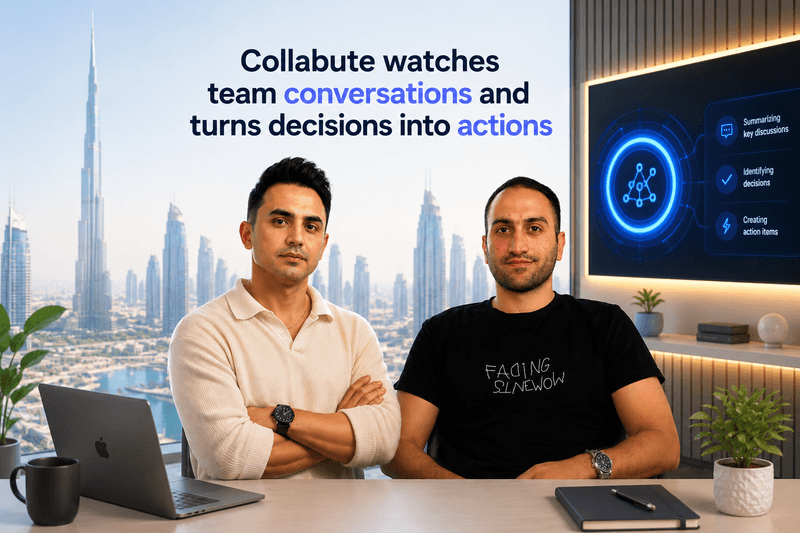
Behrooz Evans and Sadi Ghaffari, built Collabute after years of watching good work move too slowly inside government platforms. Not because people didn't know what to do, but because the context was scattered everywhere and connected by nobody. Collabute is their answer: an AI system that watches team conversations and turns decisions into action before anyone has to ask.
Product: Collabute Category: AI / Productivity / Team Collaboration Founded: 2025 Team size: 2 cofounders Website: collabute.ai SaaS Hive page: https://saashive.com/products/collabute
What were you doing before Collabute, and how did the idea come to you?
Behrooz: I was a software engineer at government platforms. After a lot of struggle with how slow teams were shipping real products, I got into building Collabute with my friend Sadi, who felt the same problem in his own experience.
Sadi: I was a product designer helping startups and enterprises build and grow their products, with a background in software engineering and UX psychology.
In one or two sentences, what does Collabute do and who is it for?
Sadi: The real pain in teams is that even when everyone knows what needs to happen, you still have to talk to 3 or 4 people just to understand where things stood. All that context exists. It's just scattered everywhere and connected by nobody.
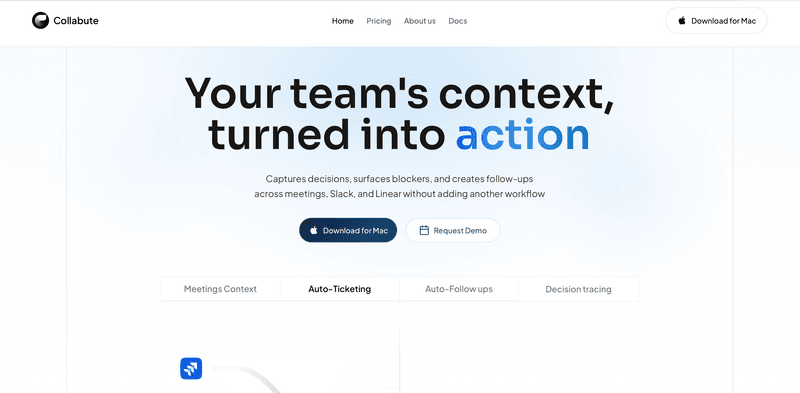
Behrooz: Collabute fixes that. It turns meetings, messages, and team context into structured work automatically. It's built for fast-moving teams that want less manual follow-up and more execution.
How long did it take to build your first version, and how much did it cost to get there?
Behrooz: We started in December 2025 and launched in February 2026. We probably spent around $1K to $2K to get there at the beginning.
What does the proactive agent actually do?
Behrooz: It doesn't wait for a user to ask. It watches for intent, context, and commitments, then creates the next action automatically. For example, turning a discussion into a task, follow-up, or structured workflow before someone manually requests it. Early users reacted strongly because it felt like the system was doing the admin work for them.
Sadi: Think of it as the system doing all the follow-up work that someone on your team is currently doing manually.
What did you spend time or money on that turned out to be a complete waste?
Behrooz: Broad social media promotion. Generic posts and unfocused distribution that didn't reach the right buyers.
Sadi: The message just wasn't sharp enough to make someone stop and think "that's exactly my problem." We reached a lot of people but started zero real conversations.
How did you get your first users?
Behrooz: Most of the early users came from our own network. People we'd interviewed before or worked with before.
Sadi: We showed them the product quickly, explained the problem in concrete terms, and asked for honest feedback. That trust made it easy for them to see the value right away.
What's the best feedback or reaction you've gotten from someone who's tried Collabute?
Sadi: One of the biggest organizations in the UAE realized Collabute removed the person who was basically just carrying context between meetings. Their team could go from discussion to execution without anyone manually owning every follow-up.
Behrooz: That was the key change. It wasn't just efficiency. The team didn't need someone chasing every action item anymore.
What's been the lowest moment so far? What kept you going?
Behrooz: Since we're bootstrapped, there are times when we can't afford the next payroll. The effort the team puts in even after knowing they might not receive a paycheck that month is just too touching.
How do you decide what to work on next? What gets priority and what gets ignored?
Sadi: We ask: does this make our core job, reducing coordination and capturing context, meaningfully better? If a request is too niche, we capture the pattern behind it and solve it at scale later.
Behrooz: We always check feature requests against the roadmap we set from day one. It was built from interviews we did with lots of teams before we wrote a single line of code.
What's the one reason someone would pick Collabute over the alternatives?
Sadi: Proactivity. Capturing things is easy. Acting based on those is the real game.
You invested in SOC 2 compliance before having any revenue. Why?
Sadi: The customers we want most, big enterprise teams, need to trust you before they'll buy. Better to build that foundation now than scramble for it later.
Behrooz: It was our lowest financial moment as a bootstrapped startup. Paying for compliance without a single client. But we understood it would help companies trust us down the line.
Where can people find or try Collabute?
Try it at collabute.ai Follow Collabute on social media: @collabute
This interview has been lightly edited for clarity and flow. All answers are Behrooz and Sadi's own words.
Comments (0)
Sign in to leave a comment.
No comments yet. Be the first to share your thoughts.