
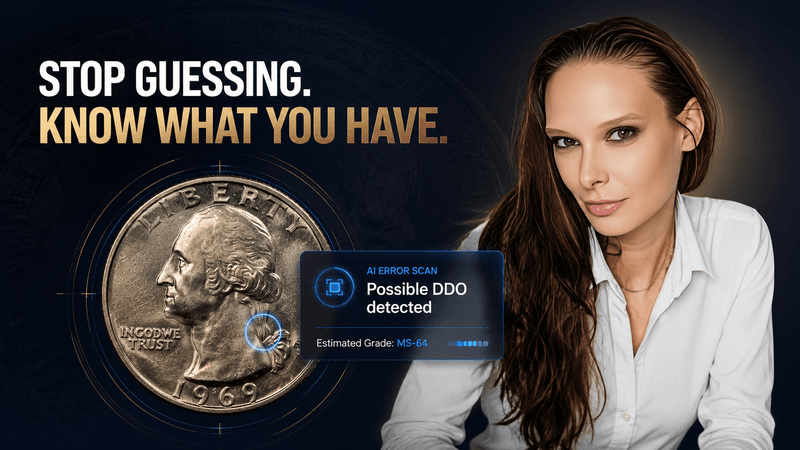
Melissa Smolk was terminated from her customer service job while on medical leave. Three years of rejection letters followed. She had no tech background and no idea how to build a website. She taught herself to code anyway and shipped Coin Error Expert for around $200, an AI platform that tells collectors exactly what they're looking at before they spend money on grading fees.
Product: Coin Error Expert Category: AI / Collectibles / Numismatics Founded: 2026 Team size: Solo founder Website: CoinErrorExpert.com SaaS Hive page: https://saashive.com/products/coin-error-expert
What were you doing before Coin Error Expert, and how did the idea come to you?
I was terminated from my customer service job while on medical leave. During my leave, I started getting into looking at coins. As a newbie, I was asking questions in some social coin groups, and needless to say, some groups are not very helpful. They expect anyone in there to have the same knowledge they do.
While getting into the hobby, I was filling out applications for employment once I was able to return to work. Over and over again for the last three years, I heard the same thing: "Thank you for your interest, but we decided to go with another candidate whose skills matched."
Frustration grew. Drowning in debt from being unemployed, I knew I couldn't wait anymore for someone to hand me an opportunity. I had to make my own.
I created this for two reasons, but the main reason was to prove a point: a resume doesn't define what a person is capable of. Skills can be taught, but dedication and drive cannot. I didn't have computer skills on my resume. I had pretty near zero tech background and didn't even know where to begin making a website. But my dedication taught me how to use the technology, and that grit deployed Coin Error Expert.
The other reason was to solve a real problem: giving collectors on any level a place to find the value of their coins, sell them, get them graded, or send them to auction without the gatekeeping.
In one or two sentences, what does Coin Error Expert do and who is it for?
Coin Error Expert is an end-to-end platform where users upload photos of U.S. coins or banknotes to get instant analysis that pinpoints exactly where an anomaly is and what visual markers to look for, saving finds to a personal vault with ready-to-print grading manifests, Avery flips, and shipping labels.
It's built for everyone from beginner collectors needing a visual guide that teaches them what to look for, to enterprise users needing automated paperwork, labels, and outreach tools to run their business.
How long did it take to build your first version, and how much did it cost to get there?
The very first version wasn't deployed at all. It was just me tinkering on Replit's free tier, trying to wrap my head around how code even worked.
Once I started understanding the tools, I tested out other platforms like Base44 and Cursor, even paying for a month of each to see if they could give me what I needed. In the end, I went back to Replit, paid to upgrade my account for the horsepower, and bought my domain through Namecheap.
Getting it live was another trial. I tried deploying to Vercel, Railway, and even paid for shared hosting on Namecheap, but none of them could handle the full stack. After a lot of trial and error, I finally got it deployed and running smoothly on Google Cloud Run.
From messing around with that first prototype to getting a live build deployed, it took about five months. Cost-wise, between the domain, the upgraded Replit plan, a month each on Base44 and Cursor, and testing out hosting providers, I got the first version live for right around $200.

What did you spend time or money on that turned out to be a complete waste?
Hands down, it was paying for multiple development platforms and chasing the wrong hosting providers before I understood deployment architecture.
Early on, I paid for monthly subscriptions to builder tools like Base44 and Cursor, along with trying out Railway and Vercel, trying to find anything that would make the build and deployment click. On top of that, when I bought my domain, I paid for Namecheap's Stellar Plus shared hosting package and separate SSL certificates, thinking that was just how you put a website online.
I wasted weeks banging my head against the wall trying to make modern, full-stack code run on traditional shared hosting, while juggling tools that weren't the right fit for my stack. None of them could run it properly.
In the end, I landed on Google Cloud Run, which handled the containerized deployment smoothly and provided the SSL certificates automatically for free. All those extra subscriptions, the shared hosting package, and the weeks spent trying to force a square peg into a round hole were a complete waste of money and time. But it ended up being my crash course in how cloud architecture actually works.
How did you get your first users, or if you're still early, how are you planning to?
Honestly, my very first user was my boyfriend because I basically forced him to test it.
Right after that, he showed it to a friend of his who actually collects coins. That was the real turning point. Seeing an actual collector scan coins and get excited about the error analysis proved to me that this wasn't just an idea in my head, but a tool people genuinely needed.
Since I'm still early, my growth strategy is twofold. On the grassroots side, it's word-of-mouth with everyday hobbyists who are tired of gatekeeping. But my big vision is going straight to the industry leaders: PCGS, PMG, Heritage Auctions, GreatCollections, and Stack's Bowers.
I'm not just waiting around hoping they notice me, either. I built pre-configured sandbox portals directly into the platform tailored to their specific requirements, like Heritage's valuation thresholds, and I've already started reaching out directly to their intake and consignment teams with ready-to-test login previews. The goal is to show them firsthand how our automated manifests and QR-code routing can save their appraisers hours of sorting through raw, unqualified submissions.
What's one decision you've made so far that had the biggest positive impact on your product or business?
Even though I haven't generated revenue just yet, hands down the best move was getting out from behind the screen and going old-school with local guerrilla marketing.
I designed physical tri-fold brochures with direct QR codes and dropped them off at local spots in my area. In tech, everyone tells you to just run digital ads or post on social media, but seeing real people physically pick up those flyers, take them home, and scan the QR codes gave me immediate, real-world validation.
It proved to me that everyday people actually have coins sitting around that they're curious about, and that face-to-face, grassroots footwork can drive genuine interest when you're building something from the ground up.
What's the best feedback or reaction you've gotten from someone who's tried Coin Error Expert?
The wildest reaction came from a friend who isn't even into coin collecting.
I showed him the platform and walked him through what it could do, from the visual AI error scanning to automated grading paperwork and partner sandboxes. He was so blown away by how complete and professional it looked that he literally went onto Product Hunt, put CoinErrorExpert.com in his bio links, and tried to claim it as one of his own projects.
What's been the lowest moment so far? What kept you going?
The lowest moment has definitely been the silence. Putting every ounce of energy into building a massive platform, and then struggling to get anyone outside of my immediate circle to actually jump on and use it. You build something you know has real value, and staring at zero strangers signing up makes you question everything for a second.
What keeps me going is pure conviction. I didn't come this far, teach myself to code from scratch, and push through months of rejections just to quit at the distribution line. I know the coin industry needs this tool, and I know how much time it saves people. That belief, and the stubborn refusal to give up on myself, is what gets me back to work every single morning.
How do you decide what to work on next? What gets priority and what gets ignored?
A huge part of my roadmap came straight from posting on SaaS Hive. When I put the product out there and asked for raw feedback, people didn't hold back. Instead of just nodding, I sat down and built their suggestions immediately.
When someone asked for an interactive demo mode with sample coins so they could test the scanner without digging out a rare error coin from their stash, I built it. When another user pointed out that sign-up needed a confirm password field to catch typos, I added that right away. If someone points out friction or an obvious blind spot, that jumps straight to the top of my priority list.
The other half is just me using the app constantly myself. As a collector, whenever I scan a coin and think, "The diagnostic rules need to be tighter here to prevent false positives on faked varieties," or "It should highlight this marker faster," that goes straight into the codebase.
What gets priority is anything that protects collector trust and removes friction. What gets ignored, or pushed way down the list, are flashy features that sound neat on paper but don't actually help a collector identify an error, print a manifest label, or prepare a submission for grading.
What's the one reason someone would pick Coin Error Expert over the alternatives?
In one word: accuracy.
Most consumer coin apps use generic image recognition. They match a picture against a loose visual database and immediately spit out wild price estimates. The problem is that in the error and variety world, generic AI hallucinates constantly. It misidentifies common post-mint damage, machine doubling, or cheap die wear as four-figure mint errors, leading people into costly mistakes.
I'm solving that by building a Retrieval-Augmented Generation (RAG) system specifically for numismatics. As far as I know, no other coin app is built on that architecture.
Instead of letting an AI model guess based on raw training data, the RAG engine grounds every visual scan against verified numismatic reference databases, strict diagnostic markers, and authenticated die variety catalogs before rendering a verdict. It tightens false-positive controls significantly. Collectors don't just want an app that guesses fast. They need an app they can actually trust when real money and grading fees are on the line.
Where can people find or try Coin Error Expert?
Test the platform at CoinErrorExpert.com
Follow Melissa on X: @CoinErrorExpert TikTok: @coin.error.expert YouTube: @melissa-w3s4y Facebook: Coin Error Expert Community Page

This interview has been lightly edited for clarity and flow. All answers are Melissa's own words.
Comments (0)
Sign in to leave a comment.
No comments yet. Be the first to share your thoughts.