
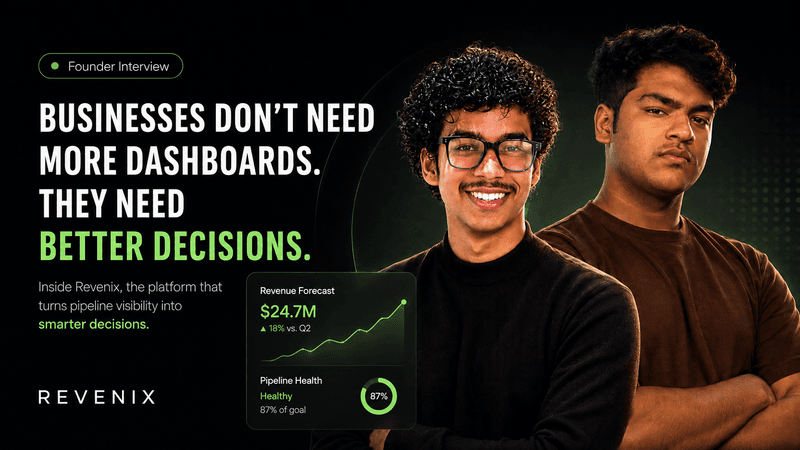
Kaustubh Pramod Chaure and Anuraj Rajesh Nambiar were running a digital agency and watching the same problem repeat with every client: leads scattered across WhatsApp, email, spreadsheets, and notes. Teams spent more time tracking opportunities than closing them. So they built Revenix in two months for under $500, while balancing college and client work.
Product: Revenix Category: CRM / Sales / Revenue Management Founded: 2026 Team size: 2 cofounders Website: revenix.vulpinixproductions.com SaaS Hive page: https://saashive.com/products/revenix
What were you doing before Revenix, and how did the idea come to you?
Kaustubh: Before Revenix, I was building Vulpinix Productions, a digital agency focused on web development, design, and digital marketing. While working with startups, small businesses, and freelancers, we kept seeing the same problem: leads were scattered everywhere. WhatsApp, emails, spreadsheets, notes, and multiple tools. Teams were spending more time tracking opportunities than actually closing them.
We didn't want another complicated enterprise CRM. We wanted a platform that made sales management simple and visual for small businesses and growing teams. Revenix was built from a real problem we saw every day while working with clients, not from a market trend.
In one or two sentences, what does Revenix do and who is it for?
Kaustubh: Revenix helps businesses capture, manage, and convert leads from a single dashboard. It's built for startups, agencies, freelancers, and sales teams that want to streamline their sales process without the complexity of enterprise tools.
How long did it take to build your first version, and how much did it cost to get there?
Kaustubh: About two months, and under $500. Most of that went toward hosting, infrastructure, development tools, testing, and software subscriptions. Since we built the product ourselves, we didn't have to spend on external developers or a team.
What did you spend time or money on that turned out to be a complete waste?
Kaustubh: We spent too much time perfecting the dashboard UI and adding customization options before users had even asked for them. We realized it wasn't worth the effort when early users turned out to be far more interested in lead tracking, pipeline visibility, and follow-ups than visual customization.
That taught us to focus on solving problems instead of polishing features nobody was requesting.
How did you get your first users?
Kaustubh: We personally onboarded our earliest users through our network and agency connections. One example was a small service-based business managing leads through spreadsheets, WhatsApp chats, and email threads. After moving to Revenix, they could track leads in one place, follow deal progress more easily, and spend less time manually updating spreadsheets.
What's one decision you've made so far that had the biggest positive impact on your product or business?
Kaustubh: Staying lean and prioritizing customer feedback over feature quantity. Rather than trying to build everything at once, we focused on solving the core lead management problems our users faced. That helped us move faster and build something people actually found useful.
What's the best feedback or reaction you've gotten from someone who's tried Revenix?
Anuraj: The feedback came from an early-stage business owner who had previously tried spreadsheets and a few CRM tools that felt overwhelming for their team. They told us, "This is exactly what I needed. It's much simpler than the tools I've tried before, but it still gives me everything I need to manage my sales pipeline."
They said Revenix was easier to adopt because it focused on the essentials they needed every day, rather than forcing them to navigate a system with dozens of features they never used.
What's been the lowest moment so far? What kept you going?
Kaustubh: One of the toughest stretches came during development when we were balancing college responsibilities, client work, and building Revenix at the same time. Progress felt slower than expected, and there were times when it seemed like we were putting in significant effort without immediate traction.
We dealt with it by focusing on small milestones, talking to users regularly, and reminding ourselves that solving a real problem mattered more than short-term results.
How do you decide what to work on next? What gets priority and what gets ignored?
Anuraj: Several users requested advanced reporting and analytics very early on. We saw the value, but we chose to delay it because users were still struggling with core lead management and pipeline tracking.
We prioritized improving the sales workflow first, because fixing the foundation would create more value than adding advanced reports that only a small number of users would use initially.
What's the one reason someone would pick Revenix over the alternatives?
Kaustubh: Lead management, sales pipeline tracking, and revenue visibility live in one workflow. Instead of switching between spreadsheets, communication tools, and separate reporting platforms, users manage opportunities from first contact through revenue tracking in one place.
Many alternatives are either too complex for small teams or too limited as businesses grow.
Where can people find or try Revenix?
Learn more and request a demo at revenix.vulpinixproductions.com
Follow Vulpinix Productions on LinkedIn: Vulpinix Productions Follow on Instagram: @vulpinixproductionsllp

This interview has been lightly edited for clarity and flow. All answers are Kaustubh and Anuraj's own words.
Comments (0)
Sign in to leave a comment.
No comments yet. Be the first to share your thoughts.