
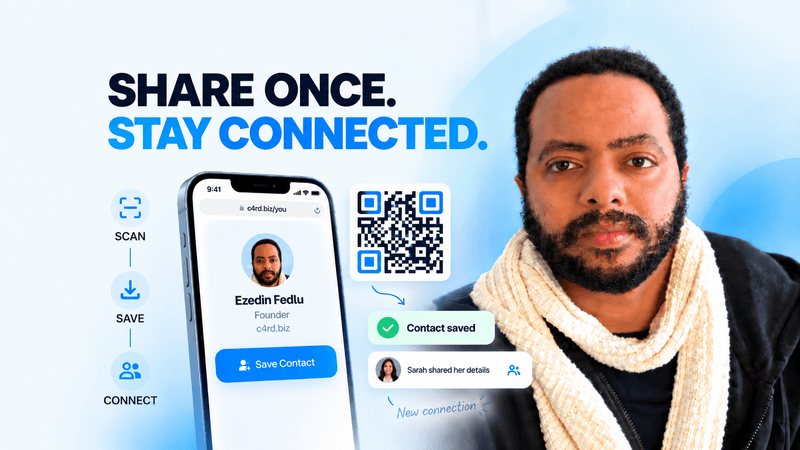
Ezedin Fedlu kept meeting people and forgetting where he met them. He started building a faster way to swap contact details, then realized the harder problem comes after the exchange. He spent $30 on a domain, built the rest himself on free tiers, and soft-launched on August 1. A few months later, someone found security weaknesses in his access controls and reported them, which turned out to be the most valuable feedback he'd received.
Product: c4rd.biz
Category: Networking / Digital Business Cards
Founded: 2026
Team size: Solo founder
Website: c4rd.biz
SaaS Hive page: https://saashive.com/products/c4rdbiz
What were you doing before c4rd.biz, and how did the idea come to you?
I'm a software engineer, and c4rd.biz started from a small frustration I kept noticing when meeting people. We exchange LinkedIn, phone numbers, or social handles, but a few weeks later I might remember the person without remembering where we met or what we talked about.
At first, I wanted to make exchanging contact information simpler. One link or QR code, no awkward spelling of usernames or searching through profiles.
But while building it, I realized the more interesting problem comes after the exchange. Saving someone's contact is easy. Remembering the context around that person months later is much harder.
That changed how I think about c4rd.biz. The digital card is the starting point. The bigger idea is helping real-world connections stay useful after the moment you meet.
In one or two sentences, what does c4rd.biz do and who is it for?
c4rd.biz lets you share your identity through a link or QR code, exchange contact details quickly, and keep context around the people you meet. It's for professionals, founders, students, event attendees, and anyone who wants their real-world connections to remain useful afterward.
How long did it take to build your first version, and how much did it cost to get there?
The first usable version took a few weeks of evenings and weekends while working full-time, and I soft-launched on August 1. My actual out-of-pocket cost was around $30, basically the domain name. I built everything myself and used free tiers for Vercel and Supabase, so I didn't have meaningful infrastructure costs at that stage.
The real cost was my time, and most of that has actually come after the first version. Watching how people use it, changing things, breaking things, fixing them, and figuring out what the product should become.
What did you spend time or money on that turned out to be a complete waste?
I spent too much time trying to expand the product before the core experience was mature. At one point I experimented with selling digital products directly from your card, and integrations with platforms like HubSpot and Google Contacts.
They weren't necessarily bad ideas, but they were solving problems much further away from why I started c4rd.biz. I ended up pulling back and focusing on the experience around meeting someone, exchanging details, and remembering that connection.
The biggest lesson was that a good feature isn't automatically a good feature for your product, especially at the stage you're in.
How did you get your first users?
I was fortunate to already have a Telegram community with more than 3,200 subscribers, so that's where I first shared c4rd.biz. I had my first 10 users shortly after launching, which made it feel real very quickly.
Crossing 100 registered users was still a special milestone. There's a big difference between building something you think people might want and watching people actually sign up and use it.
What's one decision you've made so far that had the biggest positive impact on your product or business?
Making the receiving side as frictionless as possible.
If I show you my QR code, you shouldn't need to install c4rd.biz, create an account, or understand the product first. You should be able to scan it, see who I am, save my contact, and continue the conversation.
That principle has become one of my clearest filters when deciding what belongs in the product.
What's the best feedback or reaction you've gotten from someone who's tried c4rd.biz?
When I shared c4rd.biz with my community, people didn't just sign up. They tried it, reported issues, suggested improvements, and some even contributed to the project directly.
Seeing people invest their own time in something I had built probably meant more to me than any single compliment. It changed c4rd.biz from something I was building alone into something I was improving together with real users.
What's been the lowest moment so far? What kept you going?
Someone found weaknesses in parts of the application's access controls and reported them to me responsibly.
That wasn't the kind of feedback you celebrate when you first read it, but it became some of the most valuable feedback I've received. It was uncomfortable because c4rd.biz had crossed the line from something I was experimenting with into something real people were trusting with their information.
I worked through the issues instead of treating the project as disposable. Once real people trust your product with their information, you can't hide behind "it's just a side project." Real users create real responsibility. The experience made me a better engineer and changed how I think about security and ownership when building products.
How do you decide what to work on next? What gets priority and what gets ignored?
I'm getting stricter about judging ideas against one core flow: meet someone, exchange information, remember the context, reconnect later.
If something makes that experience meaningfully better, it gets priority. If it's technically interesting but doesn't strengthen that loop, it can wait.
That's harder than it sounds when you're an engineer and building the feature is often more fun than deciding not to build it.
What's the one reason someone would pick c4rd.biz over the alternatives?
I don't want c4rd.biz to be only a digital replacement for a paper business card.
The direction I'm building toward is context. Not just who someone is, but where you met, when you met, what you talked about, and eventually helping you reconnect when that relationship matters. Your phone or LinkedIn can store a person. I want c4rd.biz to help you remember why that person matters.
Where can people find or try c4rd.biz?
Try it at c4rd.biz
Connect with Ezedin on LinkedIn
Follow on GitHub

This interview has been lightly edited for clarity and flow. All answers are Ezedin's own words.
Comments (0)
Sign in to leave a comment.
No comments yet. Be the first to share your thoughts.