
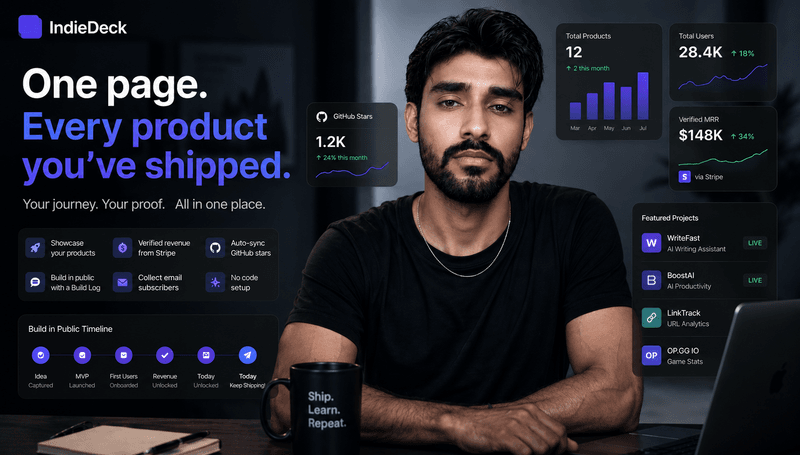
Vipul Padwal is a CS student who got tired of explaining what he's built across five different links. So he spent $13 on a domain and built IndieDeck, a link-in-bio for makers who want to prove they actually ship things. His first paying customer was celebrated with cheesecake.
Product: IndieDeck Category: Productivity / Founder Tools Founded: 2026 Team size: Solo founder Website: indiedeck.page SaaS Hive page: https://saashive.com/products/indiedeck
What were you doing before IndieDeck, and how did the idea come to you?
I was a CS student obsessed with building products and learning from other founders online. Every time someone asked what I've built, I'd start with GitHub. They'd see a wall of repos with no context. Half abandoned. None of them make sense to someone who doesn't read code for fun. So I'd send a Product Hunt link. Then a Twitter thread. Then a Notion page I half-finished 6 months ago. By the time I was done explaining, the person had already lost interest.
The problem wasn't the projects. It was that there was no single place that told the full story of what I built and shipped, whether it's alive, and why it matters. Linktree and Bento are great but they're built for influencers. They have no concept of projects, live status, or proof that you actually ship things. IndieDeck started from that frustration. I wanted a simple way for founders and makers to showcase their work and credibility in one place.
In one or two sentences, what does IndieDeck do and who is it for?
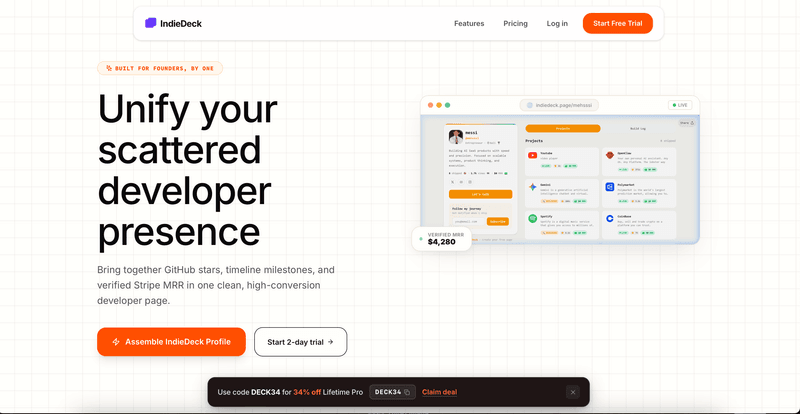
IndieDeck is a link-in-bio for solopreneurs and makers to showcase every product you've shipped, all in one place. It's built for founders and indie hackers who want an easier way to demonstrate credibility than a collection of disconnected links.
How long did it take to build your first version, and how much did it cost to get there?
I started building IndieDeck in the first week of February and launched the first production-ready version in the first week of March. Roughly one month from idea to launch.
The total cost was about $13 for the domain. I built everything myself and kept the stack intentionally lean, so there were no significant infrastructure or software costs in the early days. That's one of the things I love about building today. You can go from idea to a real product with almost no capital if you're willing to do the work yourself.
What did you spend time or money on that turned out to be a complete waste?
I spent too much time polishing things users didn't care about. Early on, I was tweaking UI details, profile layouts, and small design improvements when I should have been talking to more founders and getting the product in front of them sooner.
That reinforced a lesson I keep relearning: distribution and feedback matter far more than another week of polishing.
How did you get your first users, or if you're still early, how are you planning to?
My first users came through public launches and founder communities. I shared IndieDeck on platforms like SaaS Hive, Product Hunt, Indie Hackers, and other maker communities where my ideal customers already hang out.
Being transparent about what I was building brought in early adopters, feedback, and word-of-mouth. For a product like IndieDeck, community has been a much better growth channel than ads.
What's one decision you've made so far that had the biggest positive impact on your product or business?
Talking to users early and building based on what they actually needed rather than what I assumed they wanted. Several features that became core parts of IndieDeck, like Build log, GitHub stars, and verified MRR, came directly from those conversations. I didn't plan any of them originally.
Those discussions changed how I thought about the product and even influenced its positioning.
What's the best feedback or reaction you've gotten from someone who's seen or tried your product?
One piece of feedback that stuck with me was from a founder who said, "For the first time, I can send one link and people immediately understand what I've built."
What's been the lowest moment so far? What kept you going?
There were plenty of moments where nobody signed up, posts got ignored, and I questioned whether anyone actually cared about what I was building.
What kept me going was focusing on small wins. When I got my first paying customer, I celebrated with my girlfriend. I'd promised her that if someone ever paid for something I built, we'd go eat cheesecake together. I'd never actually had cheesecake before. The day the payment came through, we went out and finally did it.
Later that day I told my brother about the payment and he started hitting funny emotes and dancing around the room. Those moments reminded me that progress doesn't always look huge from the outside, but it means everything when you're building from scratch.
How do you decide what to work on next? What gets priority and what gets ignored?
I try to stay as close to users as possible. Most of my roadmap comes from conversations with founders, feedback from users, and watching how people actually use the product.
If multiple users are struggling with the same thing or asking for it, it moves to the top of the list. If it's a feature I think is cool but nobody is asking for, it usually gets ignored.
What's the one reason someone would pick your product over the alternatives?
Most alternatives help you share links. IndieDeck helps you prove you've actually built things.
A GitHub profile shows code. A Linktree shows links. A personal website takes time to maintain. IndieDeck brings everything together in one place: your projects, launches, achievements, GitHub activity, and even verified MRR, so people can quickly understand what you've built and your track record as a founder or maker.
Where can people find or try IndieDeck?
Try it at indiedeck.page Follow Vipul on X: @vipul20_ Connect on LinkedIn: Vipul Padwal
This interview has been lightly edited for clarity and flow. All answers are Vipul's own words.
Comments (6)
Sign in to leave a comment.
What I found interesting is the positioning. Most link-in-bio tools are built for creators, while IndieDeck is focused on showcasing proof of what you've actually built and shipped. That's a much more specific audience and a clearer problem to solve. Thanks for sharing!
Thanks Sergey and Olga! Grateful to be featured on SaaS Hive and to be part of such a supportive founder community. More building ahead.
Really liked the part about build log and Verified MRR coming directly from user conversations. It's a great example of how listening closely to users can shape a much stronger product than building in isolation.
Not surprising after reading the story behind IndieDeck. The product of the month win makes perfect sense. Congrats man! great work 👏
Love this idea. cool product!
👏👏