
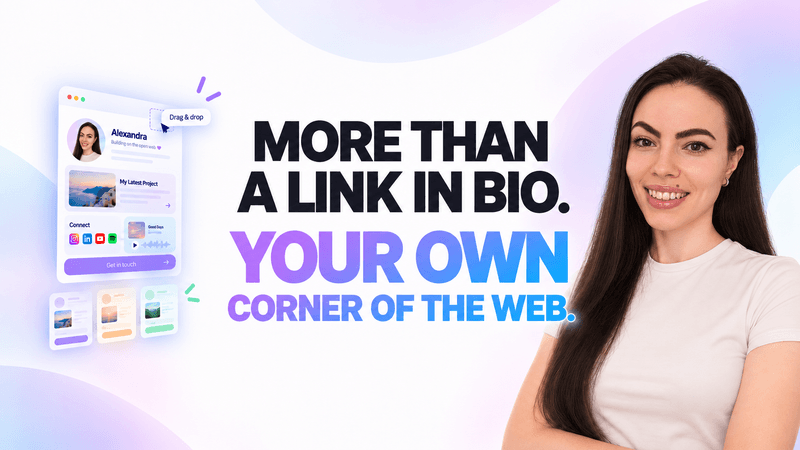
Elitza Vasileva started own.page with a fellow university student. It took three years to reach a real version, through startup programs, pivots, and two €50,000 grants. A year ago she and her co-founder parted ways and she had to decide whether to keep going alone. She kept going. own.page is now at around 12,000 users.
Product: own.page
Category: Website Builder / Creator Tools
Founded: 2024
Team size: 2
Website: own.page
SaaS Hive page: https://saashive.com/products/ownpage
What were you doing before own.page, and how did the idea come to you?
I was still pursuing my master's degree at university. Even back then, I knew I didn't want to follow the traditional corporate path. I wanted to create something of my own.
Together with a fellow university student, we joined a startup program to explore what we could build. That's where the idea for own.page was born.
It came from two different frustrations. For me, social media felt too generic and limiting when it came to creativity and self-expression. For him, building a website was still unnecessarily complicated, even with tools like WordPress and Wix.
We realized there was an opportunity to combine the simplicity of social media with the creative freedom and functionality of a website.
What does it do, and who is it for?
own.page helps creators, freelancers, and small businesses build their online presence and turn it into real opportunities. It combines a customizable page to showcase work and services with built-in tools for bookings, sales, analytics, and a custom domain, without the complexity of building a traditional website.
How long did it take to build your first version, and how much did it cost to get there?
Around three years to get to our first real version, although the actual product development was probably closer to one to one and a half years.
The rest went into startup programs, experimenting with different ideas, pivoting, and honestly, getting distracted by things that seemed important at the time but didn't move us forward.
In terms of cost, it's difficult to give an exact number. We received two grants of €50,000 each, but that funding wasn't exclusively for product development. It supported other activities throughout our startup journey.
One thing worth mentioning is that we started building before the AI boom, when developing software required considerably more manual work.
If I were starting again today, I'd do it very differently. Build the simplest possible version, launch it quickly, and let real users guide what comes next. Three years taught us a lot, but many of those lessons could have been learned much faster.
What did you spend time or money on that turned out to be a complete waste?
Startup programs. We went through several, and they were incredibly valuable in the beginning, especially for mentorship, networking, and understanding the fundamentals. But at some point they became a distraction from actually building the business.
It's easy to get caught up in workshops, events, and pitching competitions and feel like you're making progress. But being busy in the startup ecosystem isn't necessarily the same as growing a startup.
If I could go back, I'd invest much more of that time into talking to customers and finding ways to reach them. Customers don't care how many startup programs you've completed or how polished your product looks. They care whether you solve a real problem for them.
How did you get your first users?
A combination of posting on X, SEO, and direct outreach. We didn't have a marketing budget or an established audience, so we had to be proactive.
X helped me share what we were building and reach people who might find it useful. SEO attracted users already looking for solutions like ours. Direct outreach let me connect personally with potential customers and understand their needs.
One of my biggest lessons has been that distribution is just as important as development. You can build an amazing product, but if nobody knows it exists, it won't go very far. You can't just build something and wait for customers to appear.

What's one decision you've made so far that had the biggest positive impact on your product or business?
Learning to let go of perfectionism.
In the beginning, I would spend so much time improving things before showing them to anyone, because I wanted everything to be just right. But there's always something more you can improve. If you wait until everything is perfect, you might never launch.
The biggest change came when I started prioritizing action over perfection. You don't discover what works by endlessly thinking about it. You discover it by putting something into the world and seeing how people respond.
What’s the best feedback you’ve gotten from someone who’s tried it?
We've received a lot of positive feedback about the design and user experience, and that's always wonderful to hear.
But the most meaningful moment for me was when someone told me they had landed a job thanks to the portfolio they created with own.page.
That meant so much more to me than any compliment about the product itself. Our goal isn't just to help people create beautiful pages. It's to help them unlock real opportunities, whether that's landing their dream job, attracting their first client, or growing their business.
What's been the lowest moment so far? What kept you going?
The hardest moment was when I parted ways with my co-founder about a year ago. It was a difficult period, both personally and professionally, and definitely one of those times when you start questioning whether you should continue at all.
But I believed too much in what we had built to give up. We already had a working product, and there was still so much potential we hadn't explored. I knew I needed to experiment more with marketing, positioning, and different ways of reaching users before I could honestly say I'd given it my best shot.
So I decided to keep going, even though it meant figuring out a lot of things on my own.
How do you decide what to work on next? What gets priority and what gets ignored?
This is becoming an increasingly important question, especially now with AI making it so much easier to ship new features. It's tempting to constantly add something new just because you can, and I've fallen into that trap myself. But building more doesn't necessarily mean building better.
I base priorities on two things: customer feedback and actual user behavior. I listen carefully to what people tell us, especially when the same problems keep coming up. But I also pay close attention to analytics. How people use the product, where they struggle, what they engage with, and where they drop off.
What's interesting is that sometimes what users say and what they actually do are two different things. That's why combining qualitative feedback with real data is so valuable.
Instead of asking "what cool feature could I add next," I try to ask "what's the most important problem I can solve for our users right now."
Why would someone pick it over the alternatives?
own.page is much more than a simple link-in-bio tool. The idea is to give people everything they need in one place, not just to create an online presence but to understand their audience and grow it.
You can build a fully customizable mini-website with multiple pages, connect your own domain, and add interactive widgets: YouTube videos, Spotify playlists, GitHub projects, Calendly for bookings, newsletter signups, and forms to collect leads or feedback. On top of that, built-in analytics show you who's visiting, where they're coming from, and what they're clicking on.
It's about turning a static online profile into something more useful and interactive, whether you're a creator, freelancer, founder, or small business.
We're in a crowded market, and I think it's important to acknowledge that. Features can be copied. In a world where products are becoming easier to build and harder to distinguish, I believe trust and the relationship you build with your customers will become some of the strongest competitive advantages.
Where can people find it?
Learn more at own.page or create one in a few minutes at app.own.page
Connect with Elitza on X: @ElitzaVasileva
LinkedIn: Elitza Vasileva

This interview has been lightly edited for clarity and flow. All answers are Elitza's own words.
Comments (0)
Sign in to leave a comment.
No comments yet. Be the first to share your thoughts.